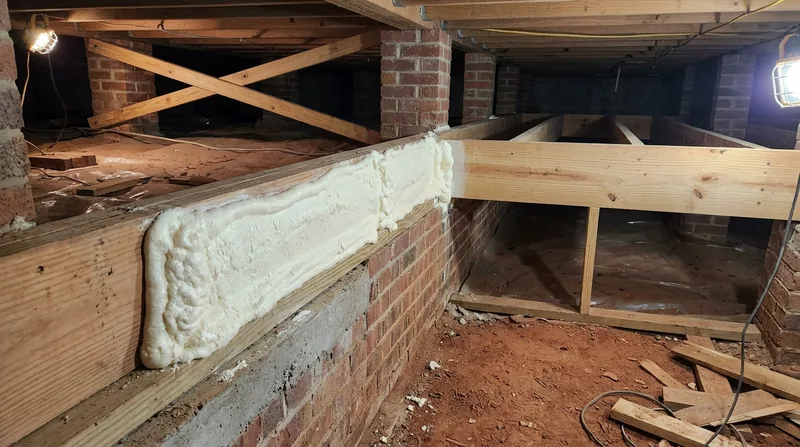




Durham's rolling Piedmont landscape sits on red clay beneath dense oaks and pines, and most homes rest on vented crawl spaces raised on brick piers or daylight basements on sloped lots. Above them, air handlers and ductwork bake in vented attics that hit 130 to 150 degrees Fahrenheit through long humid summers. The real energy leak in these houses, though, lives in the rim joist and band joist, the wooden frame that wraps the top of the foundation and the underside of the first floor. Rim joist and band joist spray foam seals the air gaps in that frame, stops conditioned air from bleeding into the crawl space or basement, and delivers one of the fastest comfort paybacks in a Durham house. We have been doing this work since 2012, and we know the Durham building stock, the humidity that drives every insulation decision, and the closed-cell foam that seals these gaps for good.
Why Rim Joist and Band Joist Air Leaks Matter in Durham Homes
The rim joist is the band of wood that sits on top of your foundation wall and supports your first floor. In Durham, whether your home sits on a crawl space or a daylight basement, that rim joist is almost never sealed. Conditioned air from your living space leaks down through every gap in the framing, past rim vents, and into the unconditioned space below. In summer, warm humid air from outside seeps back up through the same gaps. The result is a constant exchange of outside air with your climate-controlled interior, which forces your air handler to run harder and longer. The humidity that Durham's subtropical climate brings makes this worse. A rim joist that is not sealed is also a direct path for moisture and outside air to reach the rim board itself, which can lead to wood decay over time.
- Seal air leaks at the rim joist and stop conditioned air from bleeding into unconditioned spaces below.
- Reduce the load on your HVAC system by eliminating a major source of air infiltration.
- Protect the rim board and band joist from moisture and humidity that drive decay in Durham's climate.
- Improve comfort in rooms above crawl spaces or basements, which often feel cold or damp in winter and muggy in summer.
These four outcomes add up to lower utility bills, longer structural life, and a more stable indoor climate year-round.
Key info: Durham sits on red clay and humidity. The closed crawl space model was proven right here in the Southeast, and it starts with sealing the rim joist. Homes in Hope Valley, Forest Hills, and Lakewood built in the 1920s to 1960s sit on vented crawl spaces that pull humid air in all summer long. Closed-cell foam on the rim joist is the first step toward controlling that moisture.
For more detail on how moisture drives insulation choices in Durham, see our crawl space spray foam insulation page.
How We Seal Rim Joists and Band Joists in Durham Homes
Rim joist sealing is a straightforward job, but it has to be done right. We start by inspecting the rim joist from the crawl space or basement side to map out the gaps, measure the linear footage, and spot any moisture or damage that needs attention before we spray. We then prepare the surface, removing any loose debris or old insulation that sits in the way. We spray closed-cell foam to the thickness and R-value that the job calls for, filling every gap and void in the rim board and band joist. The foam expands and hardens, creating an air seal and a thermal barrier that stops both air infiltration and heat loss. We do not spray over wet substrates, and if we find standing water or active moisture in the crawl space, we stop and walk away.
- We inspect the rim joist from below to identify all gaps, measure the scope, and check for moisture or decay.
- We prep the surface by removing loose material and ensuring the substrate is clean and dry.
- We spray closed-cell foam to the specified thickness, filling gaps and voids in the rim board and band joist.
- We allow the foam to cure fully and verify the seal with a visual inspection before we leave the job.
The whole job typically takes a few hours, depending on how much linear footage we have to cover and how accessible the rim joist is.
Local example: A 1950s brick ranch in Watts-Hillandale with a vented crawl space on brick piers had a rim joist that was never sealed. The homeowner noticed cold drafts coming up through the floor in winter and high humidity in the basement in summer. We sealed the rim joist with 1.5 inches of closed-cell foam, which stopped the air leak, stabilized the basement humidity, and made the first floor feel warmer without running the heat higher.
Learn more about how we approach air sealing in Durham homes.
Rim Joist Sealing Methods and Foam Types
| Approach | Description | Best for |
|---|---|---|
| Closed-Cell Spray Foam | Rigid, high-density foam sprayed to 1 to 2 inches. Expands and hardens into a solid air seal and vapor barrier. R-value of 6 to 6.5 per inch. | Rim joists in vented crawl spaces and over basements. Provides both air sealing and moisture control in Durham's humid climate. |
| Open-Cell Spray Foam | Lower-density foam, softer and more flexible. Expands to fill gaps but is permeable to vapor. R-value of 3.5 to 3.8 per inch. | Interior rim joists where vapor permeability is acceptable and cost is a primary concern. Not recommended in Durham crawl spaces due to humidity. |
| Closed-Cell over Existing Insulation | Spray closed-cell foam over old fiberglass batts or blown-in insulation already in place. Creates an air seal and thermal upgrade without removal. | Retrofit jobs where existing insulation is intact but the rim joist is not sealed. Avoids the cost and mess of removal. |
| Closed-Cell with Removal | Remove old, degraded, or failing insulation first, then spray closed-cell foam to seal and insulate the rim joist. | Jobs where old insulation is wet, compressed, or contaminated. Ensures a clean substrate and maximum foam performance. |
Closed-cell foam is the standard for rim joists in Durham because it seals air gaps and resists moisture, both critical in a humid subtropical climate on red clay with vented crawl spaces.
Rim Joist and Band Joist Spray Foam Cost in Durham: What to Expect
Rim joist and band joist spray foam jobs start at $650 and scale with the linear footage of the rim joist you need to seal. A typical single-story home with a crawl space foundation has 120 to 150 linear feet of rim joist. A two-story home or one with an irregular footprint can run 180 to 250 linear feet. The cost also depends on how accessible the rim joist is from the crawl space or basement, whether there is existing insulation to remove, and the thickness of foam required to meet your R-value target. A home in Chapel Hill with a daylight basement on a sloped lot might have 80 linear feet of exposed rim joist but easier access, while a raised cottage in Old North Durham might have 140 linear feet in a tight crawl space that requires more time to navigate.
The best way to understand what your job will cost is to get a written estimate that specifies the linear footage, foam thickness in inches, R-value, and total board feet of material. We provide all of that in our estimates, and we encourage you to get 2 to 3 estimates from different contractors so you can compare scope and pricing directly. For a full overview of how we price insulation work across all services, see our pricing page.
Pricing reality: A 120-linear-foot rim joist sealed with 1.5 inches of closed-cell foam (roughly 15 board feet) typically runs $650 to $950, depending on access and substrate prep. A 180-linear-foot job on a two-story home runs $950 to $1,400. Jobs that require insulation removal or extensive moisture remediation cost more. We give you a firm number in writing before we start.
Rim Joist and Band Joist Spray Foam Near Me: What Durham Homeowners Should Know When Hiring
When you call a spray foam contractor to seal your rim joist, you are hiring someone to spray a chemical product inside your home. That person should be fully insured, should provide a written estimate with R-value and thickness specs, and should be reachable if something goes wrong after the job is done. Ask any contractor you call whether they carry general liability and workers compensation insurance, and ask them to provide a certificate of insurance before the work starts. Get your estimate in writing, and make sure it specifies the linear footage, foam thickness in inches, R-value, and the total cost. Do not accept an estimate with only a price and no technical detail, and do not accept a price that is far below market with no inspection of the site.
Permits and registration requirements for spray foam work vary by city across Greater Durham and the surrounding counties. Durham, Chapel Hill, Carrboro, Cary, Morrisville, and Apex each have their own building department and their own rules. Before you hire, ask your contractor whether a permit is required at your address, and ask them to help you understand what applies. You can verify what your city requires by calling your local building department directly. Some cities require a general contractor license, others do not. North Carolina does not have a statewide license for spray foam insulation, so the contractor registration regime depends on where you live.
- Ask for a certificate of insurance and verify the contractor is fully insured before the work starts.
- Get a written estimate that specifies linear footage, foam thickness in inches, R-value, and total cost.
- Ask whether a permit is required at your address and who is responsible for pulling it.
- Call your local building department to confirm what contractor registration or licensing applies in your city.
- Ask for references from recent rim joist jobs in your area and call them to ask about their experience.
- Verify that the contractor will not spray over wet or contaminated substrates, and that they will walk away if conditions are not right.
The best contractors are the ones who say no to bad conditions and who are transparent about cost and scope. Call us at (984) 254-5400 for a free written estimate with full technical specs.
Rim Joist & Band Joist Spray Foam in Durham: Pricing Guide
| Service | Price | Details |
|---|---|---|
| Single-story rim joist (120 to 150 linear feet) | Starting at $650 | Closed-cell foam 1 to 1.5 inches thick, includes prep and inspection, accessible crawl space |
| Two-story rim joist (180 to 250 linear feet) | Starting at $950 | Closed-cell foam 1.5 to 2 inches thick, covers larger footprint, includes all prep and material |
| Rim joist with insulation removal | Starting at $1,100 | Remove old fiberglass or degraded insulation first, then spray closed-cell foam to seal and insulate |
| Complex or moisture-involved job | On estimate | Wet substrate, extensive prep, tight crawl space access, or structural repair needed before foam |
| Travel and estimate | Free | No separate mileage or call-out fee in Durham and surrounding service areas, written estimate within 24 hours |
Indicative pricing, the exact cost depends on square footage, finish, and site access. Free personalized estimate within 24h at (984) 254-5400.


