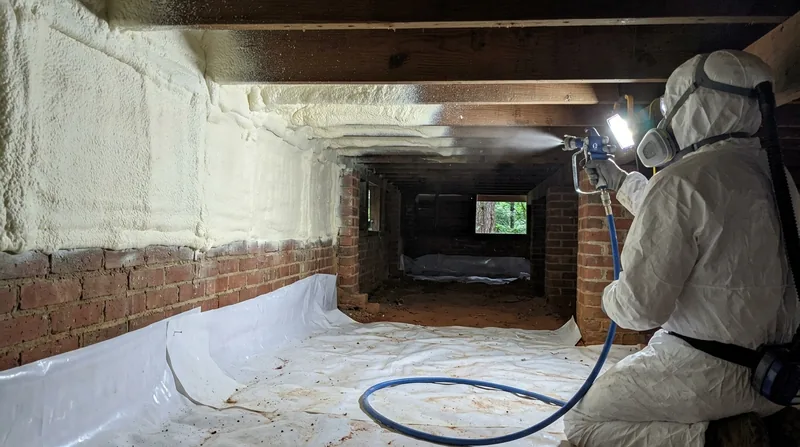




Closed cell spray foam insulation in Durham is the answer to what makes a house uncomfortable in the Piedmont: humidity. Durham sits on red clay under oaks and pines, with homes built on vented crawl spaces that sweat through long, muggy summers. The air handler in your attic bakes at 130-150 degrees while moisture creeps up from below. Two-pound closed-cell foam delivers R-6.5 per inch with its own vapor retarder and real structural stiffening. It seals the envelope where it counts most: crawl space walls, daylight basements, metal buildings, and the rim joists where the Carolina moisture pushes hardest. We have been doing this work since 2012, and we know what works on a red-clay foundation under a dense canopy.
Why Closed Cell Spray Foam Matters in Durham's Humid Climate
Durham's climate is the problem that closed cell solves. Your crawl space sits on clay that never fully dries. Your attic vents to the outside, which means summer humidity flows in under the soffit and settles on your fiberglass batts, turning them into a damp, compressed blanket. The Craftsman bungalows of Trinity Park and Old West Durham, built in the 1920s on brick piers with empty wall cavities, take on moisture from below and lose conditioned air through walls. The newer two-stories in Cary and Apex with finished rooms over the garage (the FROG) leak heat and cool air through uninsulated band joists and rim boards. Closed cell foam stops that moisture at the source.
- It acts as its own vapor retarder, so you do not install a separate membrane and create a trapped-moisture cavity.
- It stiffens metal building panels and rim joists against structural flex and condensation damage.
- It closes the rim joist and band joist, the thermal and air leak boundary that fiberglass cannot seal.
- It handles crawl space walls without rot, unlike fiberglass batts that absorb moisture and fail in ten years.
- It resists mold and does not support rodent nesting the way blown-in cellulose does.
In a humid subtropical climate where crawl space moisture and attic heat are the two failure modes that dominate, closed cell foam is not a luxury. It is the product that keeps the envelope intact.
Key info: North Carolina's building code requires a thermal barrier (typically drywall or intumescent paint) between the foam and the living space. A fifteen-minute thermal barrier is the standard in residential attics. Your local building department in Durham, Chapel Hill, Cary, or Apex sets the rule for your address. We follow it. Do not let a contractor skip it or promise a foam that does not need one.
For more on how closed cell compares to open cell in your specific application, see our open cell spray foam insulation page.
How We Install Closed Cell Spray Foam in Durham Homes and Buildings
Closed cell foam installation is a precision job. The foam is mixed at a specific drum temperature, sprayed in controlled passes to reach the target thickness and R-value, and allowed to cure in a mechanically ventilated space. We do not spray over a wet substrate, a leaking roof, or standing water. We fix the moisture first or we walk away. That discipline is what separates a durable installation from a smell that will not go away and a foam that delaminates in five years.
- We inspect the space and identify moisture, air leaks, and structural issues that must be addressed before foam goes down.
- We set up mechanical ventilation to control VOC off-gassing during cure and establish a safe re-entry window of 24 to 48 hours.
- We spray the foam in passes, measuring thickness and density on site to hit the R-value in your written estimate.
- We trim the foam flush with the rim board, joist, or roof deck and install the required thermal barrier (drywall, intumescent paint, or fiberglass facing per code).
- We seal all gaps around electrical, plumbing, and HVAC penetrations with foam or caulk to close the envelope completely.
A crawl space in Hillsborough with a damp clay floor and brick piers gets closed cell on the walls from footer to band joist, sealing the rim and the band. A daylight basement in Chapel Hill with a sloped lot and water seepage gets closed cell on the foundation wall below grade, paired with proper grading and downspout management above. A metal building or barndominium gets closed cell on the underside of the roof deck to stop condensation and the drip that rusts out equipment and feed storage.
Local example: A 1950s brick ranch in Hope Valley with a vented attic and a 130-degree summer heat load got closed cell on the rim joist and a sealed attic deck. The finished room over the garage (the FROG) that never cooled now stays 4-6 degrees cooler. The homeowner got a written estimate with the R-value and thickness specs before we started, and the job took two days from prep to cure.
For more on attic insulation and sealed attic decks, see our attic spray foam insulation page.
Closed Cell Spray Foam Installation Methods and Applications
| Application | Method | Why Closed Cell Works Here |
|---|---|---|
| Crawl space walls | Spray 2-4 inches of closed cell foam on the foundation wall from footer to band joist, sealing rim and blocking moisture entry. | Red clay stays wet. Closed cell vapor retarder stops upward moisture migration. Fiberglass fails in 10 years on a damp wall. |
| Rim and band joists | Seal the rim board and band joist with 2-3 inches of closed cell foam, closing the thermal bridge and air leak at the foundation-to-wall boundary. | The rim is the worst thermal leak in a house. Closed cell stiffens it and seals it in one pass. This is the entry point for most homeowners. |
| Daylight basements | Spray the below-grade foundation wall with 2-4 inches of closed cell, then install thermal barrier. Pair with exterior grading and drainage. | Closed cell resists hydrostatic pressure and does not absorb moisture. It is the only foam that should touch a wet or damp foundation. |
| Metal buildings and barndominiums | Spray closed cell on the underside of the roof deck to create a thermal break and stop condensation drip. | Steel conducts cold. Humid interior air hits cold metal and sweats. Closed cell eliminates the dew point and keeps the building dry. |
| Sealed attic decks | Spray 4-6 inches of closed cell on the roof deck, sealing all air leaks and creating a conditioned attic space. | Closed cell vapor retarder prevents moisture from the living space getting trapped in the roof cavity. It is the right choice for a vaulted room or finished attic. |
Each application solves a specific failure mode in the Durham climate. We measure thickness and R-value on site and provide a written estimate before we start.
Closed Cell Spray Foam Insulation Cost in Durham: What to Expect
Closed cell spray foam pricing starts at around $1.20 per board foot for straightforward applications like crawl space walls or rim joists. A board foot is 12 inches by 12 inches by 1 inch thick. The cost of a job depends on the square footage, the thickness (which is determined by your R-value target), site access, and whether the substrate is clean and dry. A 500-square-foot crawl space wall at 2 inches thick is roughly 1,000 board feet. A rim joist on a 2,000-square-foot house is typically 200-400 board feet. A sealed attic deck on a 1,500-square-foot footprint at 4 inches thick is about 2,000 board feet.
Factors that move the price up include difficult access (tight crawl spaces, tall attics, metal roof pitches), substrate preparation (removing old insulation, sealing air leaks, fixing moisture before foam goes down), and structural complexity (multiple jogs, many penetrations, existing ductwork in the way). A site visit and a written estimate with R-value and thickness specs is the only honest way to quote the job. We provide that estimate for free, with a response within 24 hours.
Do not trust a phone quote or a price per square foot. Closed cell is measured by the board foot on site. Two contractors can give you wildly different thicknesses for the same R-value, and the cheaper quote may be 1 inch when you need 2 inches. Get 2-3 written estimates and compare the R-value and thickness, not just the total price.
Key info: Closed cell typically costs more per board foot than open cell, but you need fewer inches to reach the same R-value. Open cell is R-3.5 per inch. Closed cell is R-6.5 per inch. For a crawl space wall that needs R-13, you spray 4 inches of closed cell or 4 inches of open cell plus a separate vapor barrier. The closed cell is often the same total cost and is the right product for moisture-prone applications.
For a detailed breakdown of pricing by service type and a free estimate, visit our pricing page or call us at (984) 254-5400.
What to Look for When Hiring a Spray Foam Insulation Contractor Near Me in Durham
Hiring a spray foam contractor is a decision that affects your home's comfort and durability for decades. The trade has two extremes: rig-and-run crews that spray a job in an afternoon, collect payment, and disappear when the smell will not go away or the foam delaminates in five years, and national franchises that charge premium prices and subcontract the work to regional crews with no local accountability. A local independent contractor with a local address, local plates, and a reputation in Durham, Chapel Hill, Cary, and Apex is the position we occupy, and it matters.
- Ask for a written estimate that includes the R-value per inch, the target thickness, and the total board feet and cost. No R-value and no thickness on the estimate is a red flag.
- Verify that the contractor is fully insured and ask for proof of coverage. Homeowner's insurance does not cover spray foam work, and a contractor without liability insurance is a liability to you.
- Ask how the contractor handles mechanical ventilation during cure and what re-entry window they recommend. If they promise immediate re-entry or no smell, they are cutting corners on ventilation.
- Check references from jobs in your area and ask about the thermal barrier installation, the quality of the trim, and whether the homeowner had any issues after the job was done.
- If your home is in a historic district or a strict HOA (like Forest Hills or Hope Valley), verify that the contractor understands any architectural restrictions or permits that apply to exterior work.
- Confirm that the contractor is familiar with your local building code and the thermal barrier requirement for your address. If they do not mention the fifteen-minute thermal barrier, they do not know the code.
A good contractor will push back on a bad idea, recommend the cheaper option when it is the right one, and walk away from a job that has moisture or structural issues that must be fixed first. That discipline is what separates a professional from a salesman.
Call us at (984) 254-5400 or request a free estimate online. We will be honest about what your home needs and what it will cost.
Closed Cell Spray Foam Insulation in Durham: Pricing Guide
| Service | Price | Details |
|---|---|---|
| Crawl space walls (closed cell, 2-4 inches) | Starting at $1.20/board ft | Includes inspection, moisture assessment, foam application, and thermal barrier. Price varies by wall square footage and substrate condition |
| Rim and band joist sealing | Starting at $1.20/board ft | Includes full rim joist encapsulation from footer to band. Cost depends on linear feet and access difficulty around foundation |
| Sealed attic deck or daylight basement | Starting at $1.20/board ft | Includes roof deck or foundation wall spray, ventilation during cure, and thermal barrier installation. Substrate prep and old insulation removal add to final cost |
| Metal building or barndominium roof deck | Starting at $1.20/board ft | Includes condensation control and structural stiffening. Metal roofs and complex geometry may increase labor and material cost per board foot |
| Insulation removal and replacement | On estimate | Varies by volume of old insulation, disposal fees, and substrate preparation required before new foam application |
| Free estimate and site inspection | Free | Response within 24 hours at (984) 254-5400. Includes R-value and thickness specs. No obligation to book |
Indicative pricing, the exact cost depends on square footage, finish, and site access. Free personalized estimate within 24h at (984) 254-5400.


