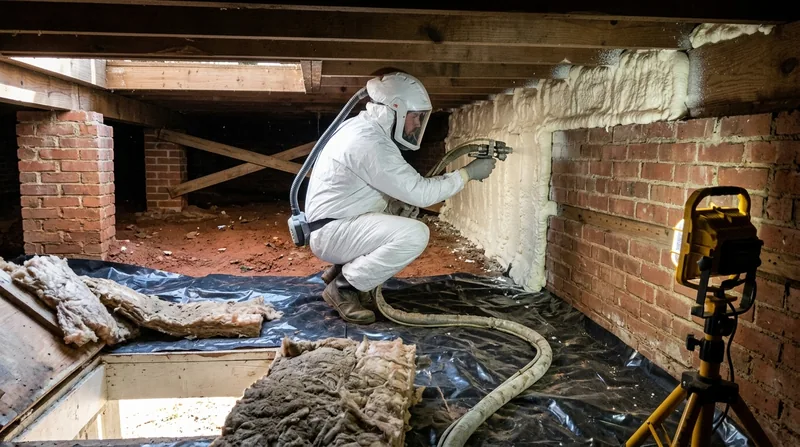




Durham's rolling Piedmont landscape, dense with oaks and loblolly pines, sits beneath homes built across a century of growth. From the Craftsman bungalows and mill houses of Old West Durham and East Durham, perched on brick piers above damp red-clay crawl spaces, to the 1920s-1960s brick ranches of Hope Valley and Forest Hills, and the vaulted two-stories spreading through Cary, Morrisville, and Apex, the region's building stock tells a story of settled attics and failed insulation. Insulation replacement and re-insulation in Durham means one thing: the full reset. When old material is flattened by decades of heat and humidity, soaked by a roof leak after a storm, or fouled by rodents, we remove it all, air-seal the gaps, and install new foam to current code. The difference between a patch and a real fix is what we do here.
Why Insulation Replacement Matters in Durham's Humid Climate
Durham's summers bake the attic to 130-150°F while humidity creeps through every gap in the envelope. Old insulation, whether fiberglass, blown cellulose, or failed foam from twenty years back, compresses under that heat, loses its R-value, and lets conditioned air leak straight into the vented attic. The humid subtropical climate means moisture drives the failure: a roof leak after storm damage, condensation wicking into the insulation from the crawl space below, or simply the slow degradation of material that was never air-sealed properly in the first place. Replacement isn't cosmetic. It's the restoration of the thermal boundary that keeps your utility bills in line and your home comfortable year-round.
- We remove all old material, including flattened or rodent-fouled insulation, before any new foam goes in.
- We identify and seal air leaks around penetrations, rim joists, and band boards that the original installation missed.
- We install new closed-cell or open-cell foam to the R-value required by current code for your attic or wall cavity.
- We verify thickness and density on every pass, with mechanical ventilation during cure and a documented re-entry window of 24 to 48 hours.
- We leave the job with a written estimate showing R-value and thickness specs so you know exactly what you have.
The result is an insulation system that actually performs, not one that looks good on a receipt.
Key info: A 1950s brick ranch in Hope Valley with original fiberglass, sagging under humidity and heat, typically sees a 20 to 35 percent drop in cooling load after a full attic replacement with closed-cell foam and proper air sealing. That's the real-world baseline for the Triangle market.
For more on what failed insulation looks like and when removal is the only answer, see our insulation removal service page.
North Carolina's building code governs the thermal barrier and ignition barrier requirements for spray foam in occupied spaces. Always verify the current code at your local building department before work begins. Permits vary by city across Greater Durham, and the building official at your address has the final say on what applies.
How We Handle Insulation Replacement in Durham: The Full Process
Replacement work is a sequence: we inspect what's there, plan the removal, clear the space, seal the air leaks, and install new foam at the right thickness and density. The process is the same whether you're re-doing a 1,200-square-foot attic in Durham or a 3,000-square-foot sealed attic in Chapel Hill. The difference is the time and the volume of material. We don't rush, and we don't cut corners on prep or cure.
- We inspect the existing insulation, measure the cavity, and assess air leaks at rim joists, ductwork penetrations, and roof framing.
- We remove all old material by vacuum extraction or manual bagging, depending on the type and condition.
- We clean and prepare the substrate, confirming it is dry and free of contamination before foam application begins.
- We air-seal gaps, cracks, and penetrations with foam or caulk, paying special attention to the band board and rim joist.
- We apply new foam in controlled passes, measuring thickness and density on site, maintaining the manufacturer's ratio and drum temperature.
- We run mechanical ventilation during cure and post a re-entry sign with the 24 to 48 hour window clearly stated.
- We provide a final inspection and a written record of R-value, thickness, and square footage.
This deliberate pace is why the job holds up and why you won't hear about odor complaints or performance failures months later.
Example: A vaulted attic in Cary with a failed open-cell foam job from 2008 (poor adhesion, water damage from an ice dam) took three days of removal, substrate prep, and new closed-cell foam application. The homeowner's cooling bills dropped 28 percent in the first summer, and the space finally stayed comfortable during peak heat.
Learn more about the difference between open-cell and closed-cell foam, and which is right for a replacement scenario, on our closed-cell spray foam service page.
Insulation Replacement Methods
| Approach | Description | Best for |
|---|---|---|
| Full removal and closed-cell foam replacement | All old material removed, substrate sealed, new closed-cell foam sprayed to design R-value with mechanical ventilation during cure. | Attics with moisture damage, rodent contamination, or failed previous foam; sealed roof decks; crawl spaces where humidity control is critical. |
| Full removal and open-cell foam replacement | Old insulation removed, air leaks sealed, new open-cell foam applied to code R-value; lower cost than closed-cell, permeable to moisture. | Attics with good ventilation; sound-dampening applications; budget-conscious replacement where moisture isn't the primary failure mode. |
| Removal and injection foam retrofit into existing walls | Old insulation removed from accessible cavities; new closed-cell or open-cell foam injected through access holes without demolition. | Pre-1980 frame homes with empty or failed wall cavities; preservation of original siding and plaster; exterior insulation without interior work. |
| Selective top-up with blown-in insulation | Existing insulation remains sound; new blown-in fiberglass or cellulose added to increase R-value in specific zones only. | Attics where original insulation is intact but below code; cost-effective R-value boost; no removal or air-sealing work required. |
Insulation Replacement and Re-Insulation Cost in Durham: What to Expect
A full attic replacement in Durham starts at around $2,800 for a smaller footprint (800 to 1,000 square feet) with straightforward access and no major air-sealing complications. That baseline covers removal of old material, substrate prep, closed-cell or open-cell foam application to code R-value, and mechanical ventilation during cure. The cost rises with the size of the space, the complexity of air sealing (how many rim joists, ductwork penetrations, or cathedral ceilings), and whether you choose closed-cell (higher R-value per inch, better moisture control) or open-cell (lower cost, permeable). A vaulted or cathedral ceiling, a complex roof geometry with multiple hips and valleys, or a crawl space that also needs replacement will push the estimate higher. Removal of old insulation adds to the labor but is non-negotiable if you want a real fix.
The best way to know what your job costs is to get three written estimates that break down removal, air sealing, foam type, thickness, R-value, and total square footage. A one-page estimate with no R-value and no thickness spec is a red flag: you don't know what you're buying. We provide written estimates with all those details so you can compare apples to apples. Call us at (984) 254-5400 for a free, no-obligation estimate, or visit our full pricing page to see the baseline for your zip code and job type.
Insulation Replacement and Re-Insulation Near Me: What to Look for When Hiring a Contractor in Durham
The insulation trade has a reputation problem. Some contractors show up with a trailer, spray an attic in an afternoon, and disappear. When the smell lingers or the foam doesn't adhere or the thickness is uneven, there's no one to call. Others are national franchises with corporate insurance but no local accountability. The local independent shop, fully insured and reachable by phone, is the middle ground. When you're hiring any spray foam contractor in the Durham area, here's what to verify.
- Ask for proof of full insurance coverage, including general liability and workers' compensation; call the insurer to confirm the policy is active.
- Request three to five references from jobs in Durham, Chapel Hill, or Cary done in the past two years, and call them to ask about odor, performance, and follow-up.
- Get written estimates from at least two contractors; compare the R-value, thickness, square footage, and removal cost line by line.
- Verify that the contractor will run mechanical ventilation during cure and post a re-entry window of 24 to 48 hours, not promise immediate occupancy.
- Ask whether the contractor pulls permits; North Carolina requires permits for certain insulation work depending on your city and the scope, so clarify what applies at your address.
- Check with your HOA if you live in a master-planned community like Woodcroft, Briar Chapel, or Southpoint; some have architectural rules that govern exterior work on metal buildings or additions.
A contractor who can't answer these questions clearly, or who offers a price far below the market with no inspection, is not the one to hire. We're fully insured, we've been in business since 2012, and we're reachable at (984) 254-5400. Contact us for a free estimate and we'll walk you through the whole process.
Insulation Replacement & Re-Insulation in Durham: Pricing Guide
| Service | Price | Details |
|---|---|---|
| Attic replacement, 800-1,200 sq ft, closed-cell foam | Starting at $2,800 | Removal of old insulation, air sealing, closed-cell foam to code R-value, mechanical ventilation during cure |
| Attic replacement, 1,200-1,800 sq ft, open-cell foam | Starting at $2,200 | Full removal and replacement with open-cell foam; lower cost than closed-cell, ideal for well-ventilated attics |
| Wall cavity injection foam retrofit, pre-1980 homes | Starting at $1,800 | Injection foam into empty wall cavities without demolition; cost varies by wall length, cavity depth, and accessibility |
| Crawl space or rim joist replacement | Starting at $3,200 | Removal of old insulation, moisture assessment, closed-cell foam application, mechanical ventilation; humidity control is critical |
| Complex or multi-zone job (vaulted attics, additions, sealed roof decks) | On estimate | Requires on-site inspection to assess geometry, air leaks, existing conditions, and removal complexity before pricing |
| Free estimate and site visit | No cost | Response within 24 hours; written estimate with R-value, thickness, and square footage included; no obligation to book |
Indicative pricing, the exact cost depends on square footage, finish, and site access. Free personalized estimate within 24h at (984) 254-5400.


