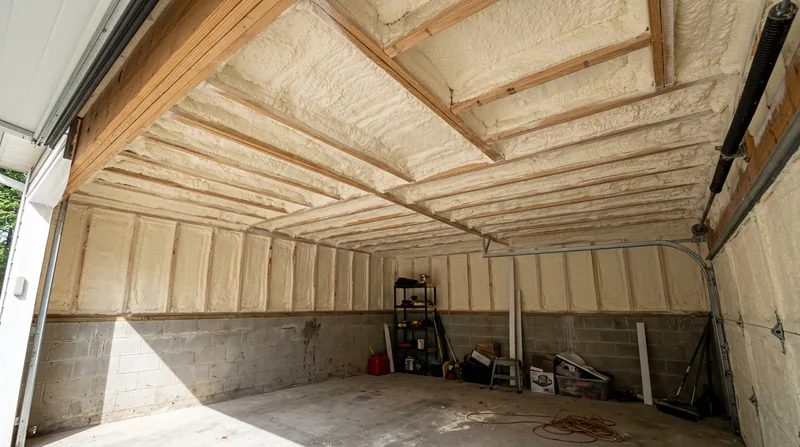




A garage spray foam insulation project transforms a storage oven into usable space. In Durham's rolling Piedmont terrain, where homes sit under dense oak and pine canopy and summer afternoons push attic temperatures to 130-150°F, the garage ceiling under a bonus room or finished workshop becomes a radiant heat trap without proper sealing. Spray foam closes the thermal bridge between conditioned space and the unconditioned garage below, stops air leakage at rim and band joists, and delivers the R-value per inch that fiberglass cannot match. Whether you are converting a workshop, insulating a FROG (finished room over the garage), or simply making a garage-adjacent space livable, the difference between a storage oven and a year-round room comes down to continuous air sealing and thermal control. We have been sealing garages and bonus rooms across Durham, Chapel Hill, Cary, and the surrounding Triangle since 2012.
Why Garage Spray Foam Insulation Matters in the Durham Heat
Durham summers are long, humid, and relentless. The typical garage sits unvented and uninsulated, allowing afternoon sun to heat the concrete and steel of the door and frame. When a bonus room or workshop sits directly above, that radiant heat radiates upward through drywall, joists, and fiberglass batts that have settled or left gaps around wiring and plumbing. A standard garage ceiling with blown-in fiberglass may have an R-value of 19 or 22, but it does not stop the thermal bridging at the rim joist, does not seal the gaps where the rim meets the foundation wall, and does not control the air leakage that lets warm garage air rise into conditioned space. Spray foam solves all three at once.
- Spray foam adheres to joists, rim board, and rim band, creating a continuous thermal and air barrier with no gaps or settling.
- Closed cell foam delivers 6.5 to 7.0 R-value per inch, so a 3-inch application yields R-20 to R-21 without the bulk of traditional batts.
- Open cell foam at 3.5 to 3.6 R-value per inch is a lower-cost option for garages where thermal performance is the goal and moisture control is not the primary concern.
- Air sealing around electrical outlets, rim joists, and band joists stops the convective loop that lets conditioned air escape into the garage cavity.
- The foam cures in place and does not settle, compress, or leave voids over time.
In Durham's subtropical humidity and long cooling season, the choice between open cell and closed cell comes down to the use case: a workshop or bonus room above the garage benefits most from closed cell, which handles moisture and delivers faster payback in energy savings.
Key info: Durham building code requires that spray foam insulation meet thermal barrier requirements for attic and wall applications. Garage ceilings under occupied space must comply with the thermal barrier rule in force at your address. We verify what applies at your location and deliver written estimates with R-value and thickness specifications so you and your builder know exactly what is being installed. Call us at (984) 254-5400 or visit the free estimate page to confirm code requirements for your project.
How We Seal Garage Ceilings: Process and Preparation in Durham
Garage spray foam insulation starts with a site visit and a conversation. We assess the rim joist, band joist, and rim board condition, check for moisture, look for gaps around electrical work and HVAC penetrations, and confirm the substrate is clean and dry. If old insulation, dust, or debris is present, we remove it first. Once the space is ready, we spray the foam in controlled passes, maintaining manufacturer specifications for drum temperature, mix ratio, and application thickness. Mechanical ventilation runs during cure and for 24 to 48 hours after, ensuring safe off-gassing and a livable re-entry window. The result is a sealed, insulated garage ceiling that stops heat transfer and air leakage.
- We inspect the rim joist, band joist, and rim board to identify moisture, old insulation, or gaps that must be sealed.
- We remove old fiberglass, cellulose, or failed foam if present, leaving a clean substrate for new foam adhesion.
- We seal gaps around electrical outlets, wiring chases, HVAC ducts, and plumbing with foam or compatible sealant before the main application.
- We apply closed cell or open cell foam in multiple thin passes, never exceeding manufacturer thickness limits per pass.
- We maintain mechanical ventilation during cure and provide a clear re-entry timeline so you can use the space safely.
- We deliver a written summary with R-value, thickness, foam type, and application date for your records and any future contractor reference.
A typical garage ceiling insulation job in Durham takes one to two days, depending on size and the amount of prep work required. If you are also sealing rim joists or band joists as part of a crawl space or basement project, we coordinate the work to avoid overlap and maximize efficiency.
Local example: A 400-square-foot bonus room over a garage in Hope Valley, Chapel Hill, or Forest Hills typically receives 3 to 4 inches of closed cell foam on the ceiling and around the rim joist, sealing the thermal bridge and stopping the afternoon heat rise that made the room unusable in July and August. The same home with open cell foam costs less upfront but delivers slightly lower R-value per inch. Both are valid depending on the homeowner's budget and the specific use of the space.
For more on the differences between foam types and when each makes sense, see our guide to closed cell spray foam insulation and open cell spray foam insulation.
Spray Foam Methods for Garage Ceiling Insulation
| Approach | Description | Best for |
|---|---|---|
| Closed Cell Spray Foam | High-density foam at 6.5 to 7.0 R-value per inch. Adheres tightly, resists moisture, and provides air barrier. Requires controlled application in thin passes. | Garage ceilings under bonus rooms, moisture-prone areas, and projects where thermal performance and durability are priorities. |
| Open Cell Spray Foam | Lower-density foam at 3.5 to 3.6 R-value per inch. Lighter, more forgiving to apply, lower cost. Allows some vapor transmission. | Budget-conscious projects, workshop insulation, and garages where moisture is not the primary concern. |
| Rim Joist + Ceiling Combo | Sealing the rim and band joist together with the garage ceiling in one continuous application. Eliminates thermal bridging and convective loops. | New construction, major renovations, and homes where the rim joist is also uninsulated or poorly sealed. |
| Removal + Re-foam | Removal of old fiberglass, cellulose, or failed foam, followed by new spray foam application. Ensures clean substrate and maximum adhesion. | Homes with settling or compressed insulation, previous water damage, or failed foam installations that need replacement. |
Garage Spray Foam Insulation Cost in Durham: What to Expect
Garage spray foam insulation in Durham starts at around $1,200 for a small garage ceiling or rim joist application and scales with size, foam type, and the amount of prep work required. A 400-square-foot bonus room ceiling with 3 inches of closed cell foam typically runs $1,500 to $2,500, depending on access, the condition of the substrate, and whether old insulation must be removed first. Open cell foam costs less because the material is cheaper and the application is faster. If the rim joist, band joist, or multiple areas need sealing, the total grows accordingly. Travel is included in our service area, which covers Durham, Chapel Hill, Cary, Morrisville, Apex, and surrounding communities.
The most common variables that affect cost are the square footage of the ceiling, the thickness of foam required to meet code and performance goals, the presence of old insulation or contamination that must be removed, and access constraints (low ceilings, tight framing, or obstacles that slow application). A written estimate includes R-value, thickness in inches, foam type, and a detailed breakdown so you understand exactly what you are paying for.
Get a free estimate by calling (984) 254-5400 or visiting our pricing page for more detail on factors that move the cost up or down. We respond within 24 hours and never obligate you to book.
Garage Spray Foam Insulation Near Me: What Durham Homeowners Should Know When Hiring
Hiring a spray foam contractor is a decision that affects your comfort, energy costs, and the long-term value of your home. Before you choose, verify that the contractor is fully insured, ask for and check references from recent garage or attic projects, and request a written estimate that includes R-value and thickness specifications. Many homeowners mistake a low price for a good deal, but spray foam is only as good as its installation: controlled drum temperature, correct mix ratio, proper application thickness, mechanical ventilation during cure, and a stated re-entry window are the markers of professional work. If a contractor promises immediate re-entry, offers no written specs, or quotes a price far below market with no inspection, walk away.
In Durham and surrounding areas, building codes govern thermal barrier and ignition barrier requirements for spray foam insulation. These rules vary by city and building official, so any contractor worth hiring will verify what applies at your address before starting. If your home is in an HOA or a historic district, check with the architectural review board about exterior work on the garage, though interior insulation rarely triggers HOA concerns. North Carolina law requires utility locates (811) before any excavation, though insulation work typically does not involve digging.
Ask your contractor for references from at least two projects in Durham or a nearby community, and follow up with those homeowners about the quality of the work, the professionalism of the crew, and whether the space is comfortable and the smell cleared within the stated timeframe. Get 2 to 3 estimates before you decide, and choose based on the quality of the estimate, the clarity of the explanation, and the contractor's willingness to answer your questions honestly. Contact us at (984) 254-5400 or through our contact page to schedule a free, no-obligation estimate and ask any questions about our process, insurance, or past projects in your neighborhood.
Garage Spray Foam Insulation in Durham: Pricing Guide
| Service | Price | Details |
|---|---|---|
| Small garage ceiling or rim joist seal | Starting at $1,200 | Up to 200 square feet with minimal prep and closed cell foam application in one visit. |
| Bonus room or workshop ceiling insulation | Starting at $1,500 | 400 to 600 square feet of closed cell foam, 3 to 4 inches thick, including rim joist sealing. |
| Open cell foam alternative | Starting at $1,000 | Lower cost option for larger ceilings where moisture control is secondary and budget is primary. |
| Removal and re-foam | On estimate | Old insulation removal, substrate prep, and new foam application require site assessment for accurate pricing. |
| Travel | Included | No separate charge for Durham, Chapel Hill, Cary, Morrisville, Apex, and surrounding service area. |
| Free estimate | No charge | Response within 24 hours at (984) 254-5400. Written quote with R-value and thickness specs, no obligation. |
Indicative pricing, the exact cost depends on square footage, finish, and site access. Free personalized estimate within 24h at (984) 254-5400.


