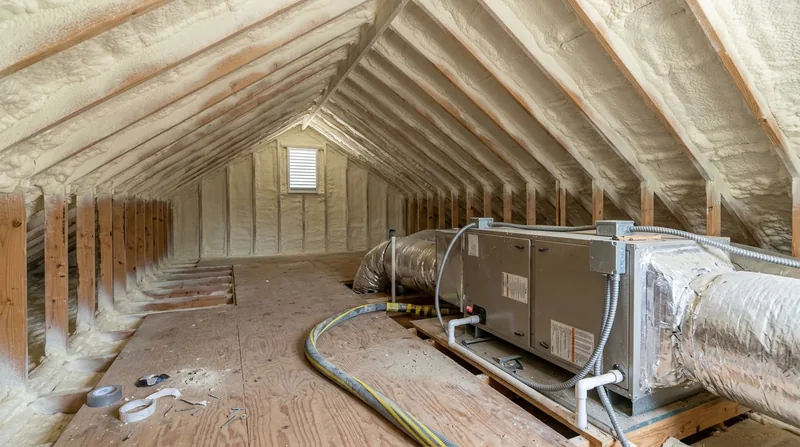




Durham's attic challenge is simple and relentless: a vented attic baking at 130 to 150 degrees Fahrenheit through long humid summers, packed with air handler and ductwork that leak conditioned air into dead space, sitting above brick piers or daylight basements on red clay that sweats moisture year-round. Whether you own a 1920s Craftsman bungalow in Trinity Park, a mid-century ranch in Hope Valley, or a newer two-story with a finished room over the garage in Cary or Morrisville, attic spray foam insulation in Durham solves the same problem: it seals the air leaks, it moves the ductwork inside the conditioned envelope, and it turns a hostile attic into part of your home. Open-cell foam on the roof deck does this work. Every estimate we write lists the R-value target, the thickness per pass, and the board footage so you know exactly what you are buying.
Why Attic Spray Foam Insulation Matters in Durham's Hot, Humid Climate
Durham summers are long and sticky. The air handler and ductwork overhead leak supply air into an unconditioned attic, and that attic radiates heat down through the ceiling into your living space. Fiberglass batts and blown-in cellulose settle, compress, and leave gaps around the ducts and the rim joist. Vented attics pull humid outdoor air across the insulation layer, which cools it and deposits moisture into the foam and the framing below. Spray foam seals the air leaks, eliminates the vented attic as a problem zone, and keeps the ductwork inside the thermal boundary where it belongs.
- Sealed attics stop the convection loop that pulls humid air across insulation and into framing.
- Ductwork sealed inside the foam envelope delivers conditioned air where you live, not into the attic.
- Open-cell foam on the roof deck breathes with seasonal humidity swings and prevents moisture trapping in the wood structure.
- A written estimate with R-value and thickness per pass tells you what you are getting and why the price is what it is.
The result is cooler summers, lower cooling bills, and a roof deck that stays dry even through Triangle humidity spikes and ice storms.
Key info: Durham sits in the North Carolina Piedmont under dense oak and pine canopy on red clay. Most homes have vented attics with air handler and ductwork overhead. That combination, plus eight months of humid subtropical weather, makes sealed attic insulation the signature retrofit in the Triangle. See our open-cell spray foam insulation page for details on how the product works in this climate.
For building code and permitting questions, check with the City of Durham Permits and Inspections Department, which administers the energy and building code for your address.
How We Spray Foam Your Attic: The Process from Estimate to Cure
Every job starts with a site visit and a written estimate. We measure the attic floor area, inspect the existing insulation, identify air leaks around the rim joist, the HVAC penetrations, the plumbing vents, and the recessed lights. We specify the R-value target, the foam type (open-cell or closed-cell), the thickness per pass, and the total board footage. We note any existing insulation that must be removed first, any moisture issues that must be fixed before we spray, and any code requirements for thermal or ignition barriers at your address.
- We remove any failed or contaminated insulation and haul it away before we spray.
- We set up mechanical ventilation during the spray and cure process to manage VOC off-gassing.
- We spray the foam in thin, even passes, controlling the ratio and drum temperature to specification.
- We seal air leaks at the rim joist, around the ductwork, and at all penetrations before we foam the roof deck.
- We confirm the thickness and coverage with a handheld measurement tool and photograph the work for your records.
- We advise a re-entry window of 24 to 48 hours before you occupy the space, depending on the foam type and weather.
The whole process takes one to three days depending on attic size and the extent of removal and prep work required.
Example: A 1,200 square-foot attic in Chapel Hill with existing fiberglass batts and a leaky rim joist takes one day to remove the old insulation, seal the rim joist with closed-cell foam, and spray open-cell foam at R-38 across the roof deck. A 1,600 square-foot vaulted attic in Apex with ductwork, recessed lights, and a finished FROG takes two days because we must seal each light can, insulate around the ducts, and manage the sloped geometry.
Learn more about insulation removal and haul-away if your attic has old or damaged insulation that must come out first.
Attic Spray Foam Insulation Methods and Materials
| Approach | Description | Best For |
|---|---|---|
| Open-Cell Spray Foam | Low-density foam that expands and cures in 24 hours. Allows vapor to pass through. Provides sound dampening. Lower cost per board foot. | Sealed roof decks in humid climates. Attics where the envelope is already conditioned and dry. Sound control in living spaces. |
| Closed-Cell Spray Foam | High-density foam that cures in hours. Forms a vapor barrier. Provides structural strength and moisture resistance. Higher cost per board foot but requires less thickness for the same R-value. | Rim joists and band joists. Crawl spaces. Attics with moisture risk. Metal buildings and barndominiums where condensation control is critical. |
| Hybrid Approach | Closed-cell foam on the rim joist and band joist, open-cell foam on the roof deck. Combines moisture control at the foundation with vapor permeability overhead. | Durham attics with damp crawl spaces below and vented attics above. Maximizes performance and cost efficiency across the whole envelope. |
| Attic Top-Up | If existing insulation is sound, we can spray foam selectively around air leaks, ductwork, and penetrations without removing the base layer. | Attics with intact fiberglass or cellulose where the goal is to seal leaks and improve R-value without full replacement. |
Attic Spray Foam Insulation Cost in Durham: What to Expect
Attic spray foam insulation in Durham typically starts at $1.50 per square foot for open-cell foam on a straightforward roof deck with minimal prep work. The final cost depends on attic size, existing insulation that must be removed, the presence of ductwork and penetrations that need sealing, and whether you choose open-cell or closed-cell foam. A typical 1,200 square-foot attic with fiberglass removal and open-cell foam at R-38 runs $1,800 to $2,400. A hybrid job with closed-cell foam on the rim joist and open-cell on the roof deck costs more because of the material difference, but delivers superior moisture control in Durham's humid climate.
- Attic size is the primary cost driver: a 1,000 square-foot attic costs less than a 2,000 square-foot attic, all else equal.
- Existing insulation removal adds labor and haul-away cost, but is often necessary because spray foam does not adhere well to old fiberglass or cellulose.
- Ductwork sealing and air-leak remediation add time and precision but are the core value of the job and reduce your cooling bills.
- Closed-cell foam costs more per board foot than open-cell, but achieves the same R-value in less thickness, which can offset some of the material premium.
- Travel is included in our service area, which covers Durham, Chapel Hill, Carrboro, Cary, Morrisville, Apex, and surrounding areas within the Triangle.
Get a free, no-obligation written estimate by calling (984) 254-5400 or visiting our contact page. We respond within 24 hours and include a detailed breakdown of R-value, thickness, board footage, and cost. See our full pricing overview for additional service costs and options.
Attic Spray Foam Insulation Near Me: What Durham Homeowners Should Know When Hiring
Spray foam insulation is a high-skill trade. A bad installation smells, leaks, or fails to seal the air leaks it was meant to fix. A good installation is invisible: it cures without odor, it seals every gap, and it delivers the R-value and thickness promised in the estimate. When you are shopping for a spray foam contractor near Durham, check three things: whether the contractor is fully insured and carries verified coverage, whether every estimate includes a written specification of R-value and thickness per pass, and whether the contractor uses mechanical ventilation during the spray and cure process.
- Ask for proof of insurance and verify the coverage limits with the insurance carrier, not just a digital copy of the certificate.
- Demand a written estimate that lists the R-value target, the foam type, the thickness per pass, and the total board footage, never a price per square foot with no specification.
- Confirm that the contractor will use mechanical ventilation during the spray and cure, and will advise a re-entry window of 24 to 48 hours before you occupy the space.
- Check references from recent jobs in your neighborhood: call two or three customers and ask whether the job was clean, whether the smell was manageable, and whether the contractor was responsive after the work was done.
- If your attic is in a historic district or an HOA-controlled neighborhood, verify that the contractor understands any restrictions on exterior work or roof modifications that may apply.
- Understand that permitting and code compliance are your responsibility as the homeowner, and the contractor's job is to execute the work to code and to help you navigate what applies at your address.
Durham Spray Foam Insulation has been in business since 2012 and serves Durham, Chapel Hill, Carrboro, Hillsborough, Cary, Morrisville, Apex, Pittsboro, and surrounding areas. We provide free estimates within 24 hours. Call (984) 254-5400 or request an estimate online with no obligation.
Attic Spray Foam Insulation in Durham: Pricing Guide
| Service | Price | Details |
|---|---|---|
| Open-Cell Spray Foam, Attic Roof Deck | Starting at $1.50/sq ft | Straightforward attic with minimal prep, no existing insulation removal, open-cell at R-38 or R-49 coverage |
| Open-Cell with Insulation Removal | Starting at $2.00/sq ft | Includes haul-away of old fiberglass or cellulose, prep work, and open-cell foam application to specified R-value |
| Hybrid: Closed-Cell Rim Joist + Open-Cell Roof Deck | Starting at $2.50/sq ft | Closed-cell foam on rim and band joists for moisture control, open-cell on roof deck, includes removal and air sealing |
| Full Closed-Cell Attic Insulation | Starting at $3.50/sq ft | High-density closed-cell foam throughout attic, maximum R-value and vapor barrier, ideal for metal buildings and extreme moisture risk |
| Travel and Mobilization | Included | No separate travel fee within Durham, Chapel Hill, Cary, Morrisville, Apex, and surrounding Triangle service areas |
| Free Written Estimate | No charge | Detailed specification with R-value, thickness, board footage, and itemized cost breakdown, response within 24 hours |
Indicative pricing, the exact cost depends on square footage, finish, and site access. Free personalized estimate within 24h at (984) 254-5400.


