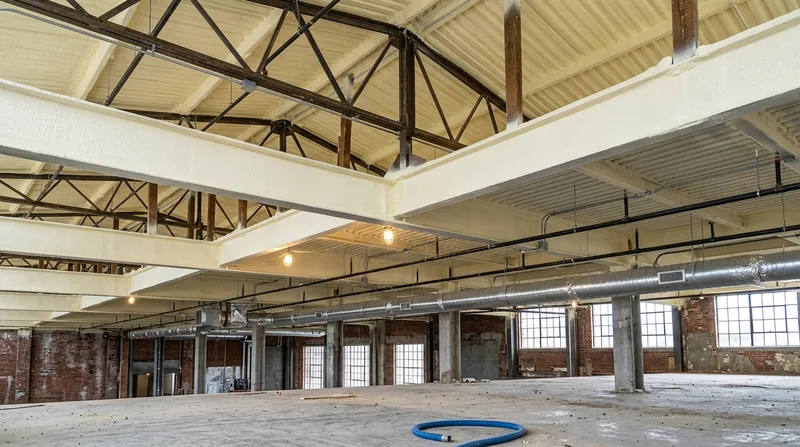




Commercial and new construction spray foam insulation in Durham demands more than a quick afternoon spray and a departure. Warehouses, office shells, churches, and production facilities across Research Triangle Park and Mebane need code-compliant assemblies that a local building inspector will actually accept, phased work that keeps your operation running, and a contractor who understands the humid subtropical climate that drives condensation into every uninsulated metal cavity and sealed assembly. Durham's commercial real estate runs from converted tobacco warehouses downtown to new distribution centers in Morrisville to the sprawling research campuses and light manufacturing that feed RTP. The red clay, the dense oak and pine canopy, and the long muggy summers mean moisture is not a future risk, it is a present condition. We deliver spray foam insulation and air sealing on schedule, with documentation your inspector will accept and the thermal and ignition barriers your code requires.
Why Commercial and New Construction Spray Foam Matters in Durham
A commercial shell or new construction project in Durham faces moisture pressure from day one. Uninsulated metal roof decks sweat in summer heat. Sealed attics above occupied spaces need a thermal barrier that meets code. New construction in Chatham Park, Briar Chapel, and the edges of Research Triangle Park requires spray foam assemblies that integrate with the building permit and the inspector's final walkthrough. A warehouse in Mebane or Morrisville without proper rim and band joist insulation will lose conditioned air and accumulate condensation on the steel frame. Closed cell spray foam solves these problems in one pass, but only when the installation is done right, the thickness and R-value are documented, and the work respects the local building code in force at your address.
- We remove existing insulation or debris before any foam goes down, ensuring a clean substrate and proper adhesion.
- We spray closed cell and open cell foam to the thickness and R-value specified by your design or code requirement, with written documentation of each pass.
- We install thermal barriers and ignition barriers as your local building code requires, not as we guess.
- We provide mechanical ventilation during cure and observe the re-entry window your local inspector expects, typically twenty-four to forty-eight hours.
- We coordinate with your general contractor and your building official so permits are pulled and inspections pass on the first visit.
A commercial job done right protects your asset, meets code, and avoids the costly callbacks and inspector delays that come from guesswork or out-of-state crews who are unreachable after they leave.
Key info: Durham's building code and permit requirements vary by city. Chapel Hill, Carrboro, Cary, Morrisville, and Apex each have their own building official and their own interpretation of thermal barriers, ignition barriers, and attic ventilation. We work with your local building department before we spray, not after. Verify your contractor's understanding of YOUR city's code before you sign.
For detailed guidance on what your local building department requires, visit the Durham Department of Development Services Building Inspection page.
How We Approach Commercial and New Construction Spray Foam in Durham
Every commercial or new construction project starts with a site survey. We walk the shell, talk to your general contractor, confirm what the code requires at your address, and understand what the building inspector will be checking. Then we schedule the work around your construction timeline, bring our equipment and crew on the day agreed, and spray to specification. No surprises, no delays, no re-entry before the foam is fully cured.
- We confirm the local building code, the thermal and ignition barrier requirements, and whether vented or sealed attics apply to your project.
- We inspect and prepare the substrate, removing old insulation, debris, or contamination that would compromise adhesion or cure.
- We spray closed cell or open cell foam in controlled passes to the thickness and density specified, measuring each section and documenting the work.
- We install mechanical ventilation during cure and post a re-entry window on site so your general contractor and occupants know when the space is safe.
- We provide written documentation of R-value, thickness, and coverage so your final inspection passes and your building file is complete.
This process keeps your project on schedule and your inspector confident that the work meets code.
Example: A new office building in Research Triangle Park required a sealed attic with a two-inch closed cell foam base and a four-inch open cell foam top layer, plus a thermal barrier. We coordinated with the general contractor, sprayed to spec, installed the thermal barrier, provided mechanical ventilation during cure, and delivered documentation for the building inspector. The project stayed on schedule and passed final inspection on the first walkthrough.
For similar coordination on your project, visit our contact page to request a free commercial estimate.
Commercial and New Construction Spray Foam Methods and Applications
| Approach | Description | Best for |
|---|---|---|
| Closed Cell Spray Foam | Two-pound closed cell foam provides high R-value per inch, acts as an air barrier and moisture barrier, and resists vapor transmission. Thickness ranges from two to four inches depending on code and design. | Metal building roofs, sealed attics, rim and band joists, condensation control, and any assembly where moisture is the primary risk. |
| Open Cell Spray Foam | Half-pound open cell foam is less dense, offers good thermal performance, allows vapor transmission, and is more cost-effective for attic insulation. Typical thickness four to six inches for R-value targets. | New construction attics in dry climates or where vapor permeability is desired, sound dampening, and interior wall cavities where closed cell cost is not justified. |
| Sealed Attic Assembly | Closed cell or open cell foam sprayed on the underside of the roof deck, eliminating attic ventilation and creating a conditioned attic space. Requires thermal barrier and proper documentation. | New construction, HVAC ductwork in the attic, or buildings where attic temperature control is critical to mechanical system performance. |
| Rim and Band Joist Insulation | Closed cell foam sprayed into the rim cavity between the foundation and the band board, sealing the thermal and air boundary. Typical one to two inch application. | Commercial buildings on piers or shallow foundations, warehouses, and new construction where foundation air leakage is a code concern. |
| Metal Building Condensation Control | Two-inch closed cell foam on the interior of the metal roof and walls, with thermal barrier. Prevents condensation drip on equipment and inventory. | Metal warehouses, agricultural buildings, barndominiums, and any uninsulated metal structure in humid climates like Durham. |
Each method is chosen based on code, climate, and the specific failure mode you are preventing. Closed cell is the standard for moisture control in Durham's humid subtropical climate. Open cell is the lower-cost option where moisture is not the driving concern. Sealed attics are increasingly required in new construction to improve mechanical system efficiency and control attic temperature.
Commercial and New Construction Spray Foam Cost in Durham: What to Expect
The cost of commercial and new construction spray foam insulation in Durham depends on the scope, the substrate condition, the foam type, the R-value target, and the complexity of the assembly. A small rim joist application is a different price than a ten-thousand-square-foot warehouse roof deck or a sealed attic in a new office building. The only honest answer is a free commercial estimate on site, where we measure, assess the substrate, confirm the code requirement, and give you a number with R-value and thickness included.
What affects the cost: the square footage of the area to be sprayed, the thickness required by code or design, whether the substrate is clean or requires removal and disposal of old insulation, access for our equipment, the complexity of the assembly (metal, wood, concrete), and whether thermal or ignition barriers are needed. A straightforward sealed attic on a new building is faster and more predictable than a retrofit of a metal warehouse with condensation damage.
We recommend getting free estimates from two or three contractors and comparing not just price but R-value, thickness, documentation, and warranty. A low estimate with no specification is a red flag. A detailed estimate with R-value, thickness per pass, thermal barrier detail, and a workmanship warranty is what you should expect.
Call us at (984) 254-5400 for a free commercial estimate with no obligation. We respond within twenty-four hours and bring a measuring tape, a knowledge of your local building code, and an honest assessment of what the job will cost.
What to Look for When Hiring a Spray Foam Insulation Contractor Near Durham
Hiring a spray foam contractor for a commercial or new construction project requires more care than calling a handyman. You are buying an assembly that will be inspected, documented, and part of your building file for decades. The contractor you choose should understand your local building code, be able to produce written documentation of the work, and be reachable if questions arise after the project is complete. Here is what to verify before you sign a contract.
- Confirm the contractor is fully insured and can provide a certificate of insurance naming your project or your company as an additional insured.
- Ask for references from commercial or new construction projects, not just residential attics, and call them to ask about code compliance and post-project support.
- Request a written estimate that includes R-value, foam thickness, coverage area, thermal barrier detail, and the local building code reference that governs the work.
- Verify that the contractor understands your local building department's requirements for thermal barriers, ignition barriers, and attic ventilation by asking them to name the rule and the code section.
- Ask how they handle substrate preparation, mechanical ventilation during cure, and the re-entry window, and whether they coordinate with your general contractor and building inspector.
- Check that any warranty is in writing and is limited to workmanship for a realistic term (one to three years), not a lifetime guarantee or an unsubstantiated manufacturer claim.
A contractor who can answer these questions clearly and provide documentation is a contractor who understands commercial work. A contractor who gives a price with no specification, promises immediate re-entry, or cannot explain your local code requirement is a contractor to avoid.
When you are ready to move forward, contact us for a free estimate and we will walk through the code, the scope, and the timeline with you before we schedule the work.
Commercial & New Construction Spray Foam in Durham: Pricing Guide
| Service | Price | Details |
|---|---|---|
| Free Commercial Estimate | Free | Site visit, code review, substrate assessment, and written quote with R-value and thickness specifications included |
| Closed Cell Spray Foam (per board foot) | Starting at $1.50-$2.25 | Two-pound closed cell foam, two to four inches thick, includes thermal barrier and documentation for inspector |
| Open Cell Spray Foam (per board foot) | Starting at $0.75-$1.25 | Half-pound open cell foam, four to six inches thick, lower cost for attic and non-moisture-critical applications |
| Sealed Attic Assembly (complete) | On estimate | Full roof deck spray, thermal barrier, mechanical ventilation, and building inspector documentation; scope and code determine final price |
| Travel and Mobilization | Included | Durham, Chapel Hill, Cary, Morrisville, Apex, and surrounding areas; no separate mileage or call-out charge |
Indicative pricing, the exact cost depends on square footage, finish, and site access. Free personalized estimate within 24h at (984) 254-5400.


