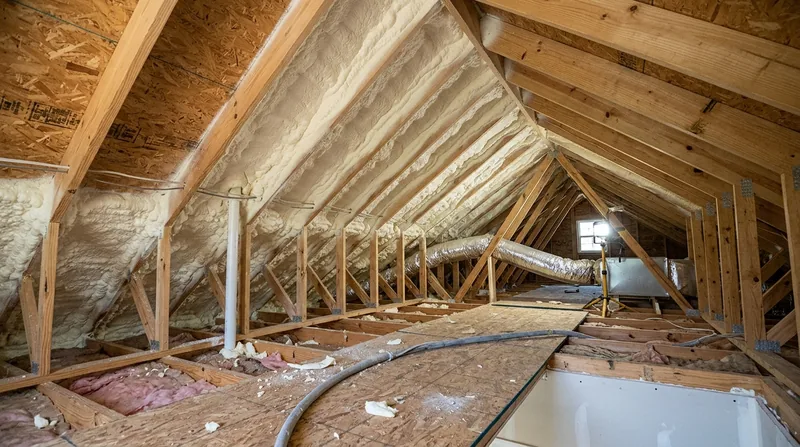




Open Cell Spray Foam Insulation in Durham is the cost-conscious answer to attic and wall air-sealing in the Triangle. Durham's 1900s Craftsman bungalows, post-war ranch homes, and newer two-stories with vaulted ceilings all share the same problem: hot, humid summer attics where standard insulation leaves gaps, and walls where fiberglass has settled or was never there. Half-pound open-cell foam seals those cavities at a friendlier price per board foot than closed cell, adds sound dampening between rooms, and handles the moisture-driven climate of the Piedmont when the substrate is dry and the work is done right. We've been doing this since 2012, and we know when open cell is the right call and when your Durham crawl space or metal building needs closed cell instead.
Why Open Cell Spray Foam Matters in Durham's Humid Climate
Durham summers are long, muggy, and relentless. Your attic bakes at 130 to 150 degrees Fahrenheit, and that heat wants out. The problem is air leakage: gaps around the rim joist where the house sits on brick piers, holes where the HVAC ductwork passes through the attic, and the simple fact that old fiberglass batts sag and leave voids. Open-cell foam fills those gaps completely, seals the air boundary, and stops the conditioned air from bleeding into the hot attic. In the walls of Watts-Hillandale or Old West Durham cottages, where the cavities are empty or partially filled, open cell retrofits without tearing into plaster or lap siding.
- Open-cell foam expands to fill wall cavities and attic framing completely, eliminating the gaps that fiberglass cannot reach.
- The material is semi-rigid and slightly flexible, so it handles the seasonal wood movement in older Durham homes without cracking.
- Sound dampening between rooms comes with the installation, a benefit closed-cell foam also provides but at a higher cost per board foot.
- Proper installation requires controlled thickness per pass, correct drum temperature, and mechanical ventilation during cure, all of which we manage on site.
When you seal the air boundary correctly, your cooling system does not have to fight leakage, and your utility bills reflect that efficiency.
Key info: Durham's building code requires a thermal barrier between foam and occupied space in most cases. That means a fifteen-minute rated drywall or intumescent coating. We verify what your local building department requires at your address, and we specify it on every estimate. The distinction between thermal and ignition barriers is where generalist installers go wrong.
For detailed information on how we approach the whole-house retrofit, see our page on Attic Spray Foam Insulation in Durham, where sealed attic decks and vented attics are explained side by side.
How We Install Open Cell Spray Foam in Durham Attics and Walls
The process starts with a walkthrough. We look at the substrate (is the attic deck dry, or is there a roof leak we need to fix first?), we check for old insulation that needs to come out, and we identify all the air leaks: rim joists, ductwork penetrations, electrical chases, and any place where conditioned air escapes. Once we know the scope, we give you a written estimate with R-value and thickness specs, so you know exactly what you are paying for and what it will deliver.
- We protect the work area and set up mechanical ventilation to clear isocyanate fumes during the spray and cure cycle.
- We spray the foam in controlled passes, typically one to three inches per application, to avoid over-pressurization and ensure even density.
- We maintain the correct drum temperature and mix ratio throughout the job, monitored in real time.
- We install the required thermal barrier (drywall or coating) over the foam to meet Durham building code.
- We establish a re-entry window of twenty-four to forty-eight hours, after which the space is safe to occupy and the foam is fully cured.
The result is an attic or wall cavity that is sealed, insulated, and compliant with code.
Example: A 1950s ranch in Chapel Hill with a vented attic and original fiberglass batts settled to R-2. We removed the old insulation, sealed the rim joists and ductwork with open-cell foam, and brought the attic to R-38. The homeowner saw a measurable drop in summer cooling costs and reported the upstairs bedrooms stayed cooler without the noise of the HVAC cycling as hard.
If your project involves insulation removal, we handle the tearout and disposal as part of the retrofit. Crawl spaces and basements may call for closed-cell spray foam instead, because moisture control on concrete and earth-contact walls is a different job.
Open Cell Spray Foam Installation Methods and Applications
| Approach | Description | Best for |
|---|---|---|
| Attic air sealing with open cell | Spray 2 to 4 inches over rim joists, band joists, ductwork, and electrical penetrations; leave the attic deck open for ventilation or seal it entirely depending on code and design. | Vented attics in Durham where the primary goal is to stop conditioned air from leaking into the hot attic space above. |
| Wall cavity retrofit with open cell | Inject or spray open-cell foam into wall cavities from the exterior or interior without removing siding or plaster; typical depth 3 to 5 inches for R-13 to R-20. | Pre-1980 Durham homes with empty cavities or partial fill; especially Craftsman bungalows in Trinity Park and Old North Durham. |
| Sealed attic deck with open cell | Spray 5 to 7 inches of open cell over the attic deck to create a conditioned attic; requires mechanical ventilation during cure and thermal barrier compliance. | New construction, vaulted rooms, and finished rooms over garages (FROGs) where the attic must be part of the conditioned envelope. |
| Sound dampening with open cell | Spray open-cell foam into walls, floors, or ceiling cavities between rooms to reduce airborne and impact noise transmission. | Interior walls in Cary, Apex, and newer two-stories where bedroom or office privacy is a priority. |
Open Cell Spray Foam Insulation Cost in Durham: What to Expect
Open-cell foam typically starts at $0.55 per board foot, making it the most affordable spray foam option for attics and wall cavities. Your actual cost depends on several factors. The size of the space and the linear feet of rim joist or band joist you need to seal affect the total board-foot count. Access matters: if your attic is easy to reach and the substrate is clear, the job moves faster. Old insulation that needs removal adds labor and disposal cost. The complexity of the thermal barrier (drywall, intumescent coating, or fire-rated paint) and the local building code requirements at your address all factor in.
A typical attic air-sealing project in Durham (rim joist, band joist, and ductwork penetrations on a 1,500-square-foot home) runs 300 to 600 board feet and costs between $1,800 and $3,500 before any existing insulation removal. A wall cavity retrofit on a single room is smaller and less expensive. A sealed attic deck on a vaulted room or FROG is larger and can exceed $5,000 depending on the area and the R-value target.
The best way to know what your job will cost is to get a free, written estimate. We give you the R-value, the thickness, the board-foot count, and the price, all in writing. No surprises, no callbacks asking for more money. If you want to compare costs, get two or three estimates from different contractors and ask each one the same questions: what is the R-value, what is the thickness per pass, what is the thermal barrier, and what is the re-entry window? The cheapest estimate is often the riskiest one.
See our full pricing page for more detail on what moves costs up or down across all our services.
Open Cell Spray Foam Insulation Near Me: What Durham Homeowners Should Know When Hiring a Contractor
Spray foam is a specialized trade, and not all installers follow the same standards. Before you hire anyone to spray foam in your Durham home, verify their insurance and ask to see a current certificate of coverage. Insurance protects you if something goes wrong on the job. Ask for references from recent work in your area, and call them. A good contractor will give you three to five names of homeowners who did the work in the past year and will talk to you about it.
Understand what your local building department requires. If your home is in an HOA in Chapel Hill, Carrboro, or one of the master-planned communities like Briar Chapel or Chatham Park, check whether there are architectural restrictions on interior work. Permits for spray foam insulation vary by city: Durham, Cary, Morrisville, and Apex all have different rules. A contractor who says "permits are not necessary" is a red flag. A contractor who says "we will help you figure out what applies at your address" is the one you want.
Get a written estimate that includes the R-value, the thickness per pass, the board-foot count, and the re-entry window. If the estimate does not include those details, ask for them in writing. If the contractor will not put it in writing, walk away. Ask about the thermal barrier requirement and how it will be installed. Ask what happens if you find a roof leak or moisture in the attic during the job. The honest answer is "we fix the moisture first or we walk away." That is not a problem, that is a sign of a professional.
Call us at (984) 254-5400 for a free estimate, or visit our contact page to request an appointment. We have been in business since 2012, and we are fully insured. We give you written estimates with R-value and thickness specs, and we answer your questions before and after the job.
Open Cell Spray Foam Insulation in Durham: Pricing Guide
| Service | Price | Details |
|---|---|---|
| Open cell attic air sealing | Starting at $0.55/board ft | Rim joist, band joist, and ductwork penetrations sealed; typical 300-600 board feet on 1,500-sq-ft home |
| Wall cavity retrofit with open cell | Starting at $0.55/board ft | Single room or whole-house injection into empty or partial-fill cavities; access and substrate condition affect final count |
| Sealed attic deck with open cell | Starting at $0.65/board ft | 5 to 7 inches over deck for vaulted rooms and FROGs; includes thermal barrier and mechanical ventilation during cure |
| Insulation removal and disposal | On estimate | Old fiberglass, cellulose, or failed foam removed and hauled away before new foam installation; labor and haul cost depends on volume |
| Travel and estimate | Free estimate, included travel | No call-out fee, no mileage charge within Durham and surrounding Triangle service area; response within 24 hours |
Indicative pricing, the exact cost depends on square footage, finish, and site access. Free personalized estimate within 24h at (984) 254-5400.


